Sculptra vs Profhilo: What Works Best for Skin Rejuvenation?
Doctor's Desk
Author
3 Nov, 2025
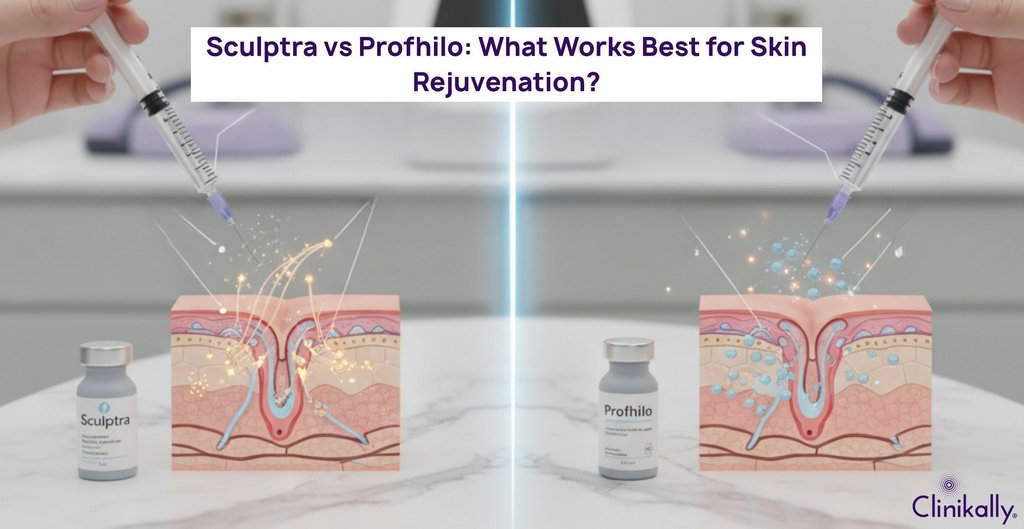
If you're looking for non-surgical skin treatments to renew your skin, you've most likely heard of Profhilo or Sculptra, or both. If you've never heard of either procedure, you're invited to join us, pull up a chair, and learn about these two significant players in the field of advanced skin treatments. Today, we'll look at what Sculptra and Profhilo are, our medical-aesthetic practitioner's thoughts on both treatments, and how they could improve your skin.
The Science Behind Injectable Skin Rejuvenation
Injectable skin rejuvenation treatments include hyaluronic acid, polynucleotides, or collagen-stimulating chemicals to hydrate, volumize, and promote collagen formation, resulting in improved skin elasticity, texture, and overall look. These treatments can address a variety of aging symptoms, such as volume loss, fine lines and wrinkles, by targeting distinct layers of the skin and activating specific biological processes. How Injectable Skin Rejuvenation Works:
-
Hyaluronic Acid (HA) injections: HA is a naturally occurring component in the skin that attracts and retains moisture, thereby hydrating and plumping the skin. Injectable HA products, such as skin boosters, can replace lost HA, increasing skin hydration, elasticity, and texture.
-
Polynucleotide (PN) Injections: PN, which is produced from DNA fragments, stimulates cellular repair and regeneration. They stimulate collagen formation and improve skin suppleness, resulting in a more young and revitalized appearance.
-
Injections that stimulate collagen production: These injections, which include poly-L-lactic acid (PLLA) and calcium hydroxylapatite (CaHA), increase the body's natural collagen production, which is required for skin firmness and suppleness. They can reduce volume loss and enhance skin texture.
-
Dermal Fillers: Dermal fillers, which are commonly formed of hyaluronic acid, are injected to restore volume and fill wrinkles and fine lines. They can also be utilized to shape and contour face features, resulting in a more youthful and harmonious appearance.
-
Neurotoxin Injections: While neurotoxins like as Botox do not immediately rejuvenate the skin, they temporarily relax facial muscles, decreasing the appearance of wrinkles caused by repeated expressions.
Understanding How Profhilo and Sculptra Work on a Cellular Level
Profhilo and Sculptra are both injectable skin rejuvenation therapies, but their biological mechanics are fundamentally different. The first improves hydration and cell signaling, while the second gradually increases fibroblast activity and collagen formation. Understanding these distinctions explains why each treatment has different outcomes and how they might even compliment one another in a personalized anti-aging routine.
The Role of Hyaluronic Acid and Poly-L-Lactic Acid in Skin Health
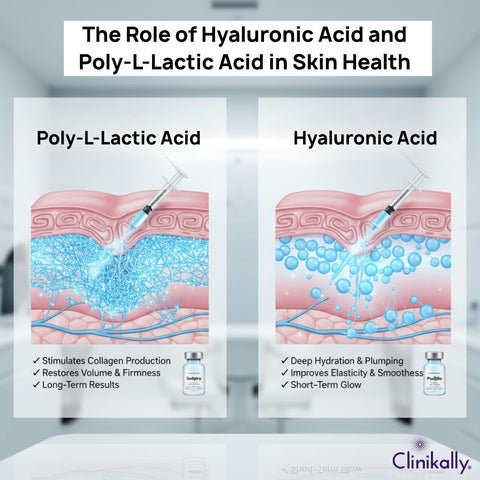
Hyaluronic Acid (HA) and Poly-L-Lactic Acid (PLLA) are two potent substances in modern aesthetic dermatology, with each serving a distinct role in supporting youthful, resilient, and healthy skin. Though both are utilized in injectable treatments such as Profhilo and Sculptra, they operate in different ways at the cellular level. Here's how each promotes skin health:
-
Hyaluronic acid (HA): Skin, connective tissue, and joints all contain naturally occurring glycosaminoglycans. Responsible for the skin's hydration, plumpness, and suppleness. HA can hold up to 1,000 times its weight in water. It draws and retains water in the extracellular matrix, increasing hydration and giving the skin a smoother, dewier appearance. Promotes wound healing, antioxidant defense, and barrier function. Injectable forms (such as Profhilo, Restylane, and Juvederm) replace lost moisture while improving skin tone and texture. Skin advantages include intensive hydration from within, greater elasticity and bounce, smoother texture and fine line reduction, increased radiance and glow, and stimulation of collagen and elastin formation (particularly with stabilized HA like Profhilo). Best for dry, dull, or crepey skin, early indications of aging, and skin without firmness or glow.
-
Poly-L-Lactic Acid (PLLA): For decades, dissolvable sutures and medical implants have been successfully made from a biodegradable synthetic polymer. Not naturally occurring in the body, yet easily tolerated. When injected (as in Sculptra), PLLA encourages the skin's fibroblasts to create new collagen over several weeks or months. It induces a regulated, low-grade inflammatory response, which promotes progressive volumization and skin thickening. Unlike HA, PLLA does not provide instant volume; the effect develops over time as collagen is regenerated. Long-term skin advantages include collagen regeneration, enhanced skin structure and firmness, facial volume restoration, and smoother, more youthful contours. Ideal for thinning or sagging skin, deep facial folds, hollow areas, older skin with volume loss, and long-term structural rejuvenation.
Collagen Biostimulation and Tissue Remodeling Explained
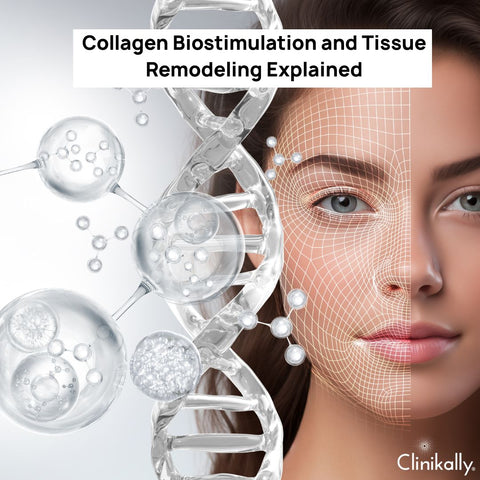
Modern cosmetic treatments such as Sculptra, Ellansé, and other biostimulatory injectables are based on a potent healing mechanism known as collagen biostimulation. Unlike standard dermal fillers, which merely "fill" space, biostimulators stimulate your body's cellular repair systems, resulting in natural, long-lasting volume, firmness, and skin density.
Collagen biostimulation is the process of stimulating fibroblasts, the cells in the dermis that produce collagen, elastin, and extracellular matrix (ECM) proteins.
-
A biostimulatory substance (such as poly-L-lactic acid in Sculptra) is injected. The body perceives it as a foreign particle and mounts a moderate, focused immunological reaction.
-
Macrophages and immune cells recruit fibroblasts to the injection site. These fibroblasts begin to produce Type I and III collagen, the primary structural proteins in youthful skin.
-
Over the course of several weeks or months, this new collagen strengthens the dermal scaffold, enhancing skin thickness, elasticity and firmness.
-
The biostimulant (such as PLLA) is finally broken down and completely absorbed, leaving a network of collagen-rich tissue.
Tissue remodeling: Tissue remodeling is the restructuring and strengthening of the skin's internal support network through new collagen deposition, improved vascularization (blood supply) and reorganization of the extracellular matrix (ECM). This leads to increased skin thickness, smoother texture and tighter, lifted appearance. It’s a progressive process—subtle but cumulative improvements unfold over several months, with peak results usually seen between 3 and 6 months post-treatment.
Treatment Benefits and Results: What to Expect

Both Sculptra and Profhilo provide remarkable skin renewal, although via completely different ways. Understanding the benefits, expected outcomes, and timings of each therapy will help you set reasonable expectations and select the best option for your skin conditions and goals.
-
Profhilo is a bioremodelling injectable containing pure, high-concentration hyaluronic acid (HA). It penetrates the skin to deeply hydrate while also stimulating modest collagen and elastin production—all without adding mass or structure. Key advantages include intensive cellular hydration, enhanced skin texture, tone, and luminosity, increased elasticity and firmness, reduced fine lines and crepiness, and healthier, more radiant skin overall. Skin appears smoother and more moisturized within 1-3 days of treatment. Visible plumpness and brightness; pores may appear smaller after 1-2 weeks. Skin becomes firmer and more elastic after four to six weeks. The biggest increase in suppleness, bounce, and tone occurs 8 weeks after the second session. Results last for 4-6 months. Maintenance is normally performed every 6 months, or 2-3 times per year for best performance.
-
Sculptra is a poly-L-lactic acid (PLLA) injection that stimulates your body's collagen production, restoring lost volume and improving skin structure from within. The key benefits include gradual restoration of face volume, a softer appearance of deep folds, hollows, and wrinkles, thicker, firmer skin with improved texture, long-term collagen rebuilding, and a natural, subtle lift without the "filled" look. The results timeline includes weeks 0-2 with limited observable change as the product is absorbed. In weeks 3-6, collagen production begins; the skin may feel firmer. Within 3-6 months, volume progressively increases, folds relax, and overall contour improves. After 6 months, the skin seems younger, more lifted, more robust. Results last for 18-24 months. Maintenance is typically performed every 1-2 years, with occasional modest top-ups.
Hydration vs Volume: Key Differences in Outcomes
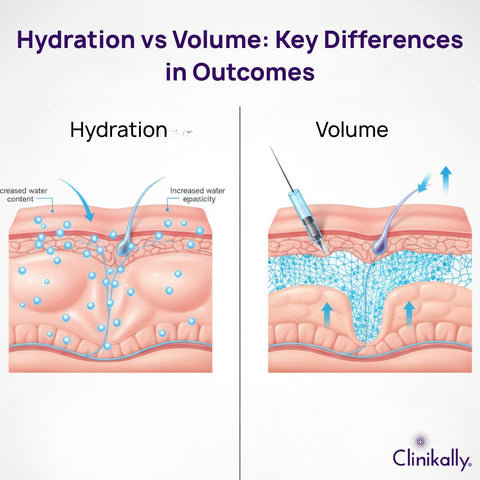
When comparing skin hydration and volume restoration, particularly in the context of injectable treatments such as Profhilo (hydration-focused) and Sculptra (volume-focused), it is critical to recognize that they target different layers and cellular processes, resulting in very different aesthetic outcomes. Both are necessary in the aging process—but the choice depends on what your skin genuinely requires.
-
Hydration: Hydration treatments increase the water content of the skin, boosting its plumpness, suppleness, and radiance without changing facial structure or shape. Uses hyaluronic acid (HA) to bind water in the extracellular matrix. Acts as an internal moisturizer, enhancing skin smoothness, bounce, and barrier function. Improves cellular communication and prepares the skin for collagen formation. Profhilo includes pure and stable HA (not a filler). Spreads evenly, hydrating the mid and deep dermis. Mildly stimulates fibroblasts to improve skin texture, tone, and firmness.
-
Volume: Volume restoration aims to replenish lost fat and collagen in deeper layers of the skin, restoring youthful curves and lifting sagging tissues. Uses collagen-stimulating chemicals such as poly-L-lactic acid (PLLA). Fibroblast activity is triggered, leading to the production of a new collagen matrix. Fills in deep hollows, folds, and flat facial areas.
Skin Texture, Firmness, and Radiance Improvement

Achieving youthful, healthy-looking skin entails more than just reducing wrinkles; it also includes enhancing skin texture, restoring firmness, and recovering natural radiance. Injectable biostimulants such as Profhilo and Sculptra are intended to work beneath the skin's surface, addressing the deeper biological mechanisms that keep these visible characteristics. Each treatment improves texture, tone, and radiance, demonstrating why they're at the forefront of regenerative skin care.
-
Skin texture (smoother, softer surface): Profhilo's high-concentration hyaluronic acid (HA) distributes uniformly across the mid to deep dermis. Deep hydration enhances cell cohesiveness and turnover while minimizing roughness and flakiness. Improves the skin barrier, leaving the surface smoother and more resilient. Sculptra indirectly enhances texture by increasing collagen production, which thickens the dermis. Over time, the skin's surface becomes more even, taut, and consistent.
-
Firmness (structural support and elasticity): Profhilo promotes elastin and collagen formation in fibroblasts (to a limited extent). Hydrated skin recovers faster and is less prone to drooping. On the other hand, Sculptra's deep biostimulation of Type I and III collagen results in genuine dermal remodeling. Rebuilds the skin's inner framework, increasing tensile strength and support.
-
Radiance (glow from within): Profhilo deeply hydrates the skin at the cellular level, boosting light reflection on the surface. Enhances microcirculation and nutrient delivery to the skin. Sculptra, on the other hand, does not directly boost glow; instead, it thickens the dermis and restores structure, smoothing shadows and contours that dull the complexion.
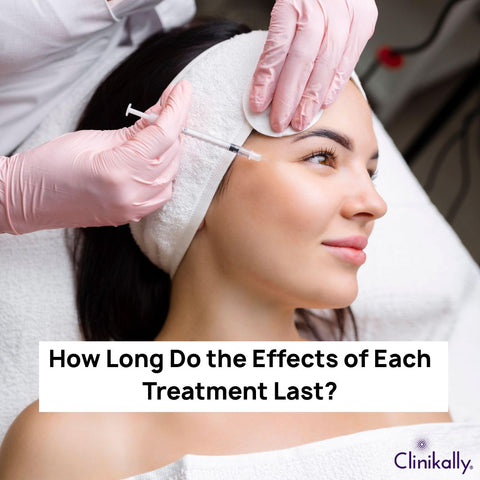
How Long Do the Effects of Each Treatment Last?
-
Profhilo (Hydration and skin quality): Profhilo is composed of stable, non-crosslinked hyaluronic acid (HA). It does not fill or develop structure, but rather improves skin hydration, elasticity, and texture through bio-remodelling. Within 3-7 days, you will notice a visible radiance and plumpness to your skin. Firmness, texture, and elasticity 4-6 weeks later (often after the second treatment). Typically, it lasts four to six months. Some people get improvements for up to 9 months, depending on their age, skin condition, lifestyle (sun exposure, smoking, hydration), and skincare regimen. The initial procedure included two sessions separated four weeks apart. Refill once every six months. For extremely dry or aged skin, a third treatment at 8-12 weeks may prolong benefits.
-
Sculptra (Collagen stimulation and volume restoration): Poly-L-lactic acid (PLLA) is a biostimulant that causes the skin to progressively create its own collagen. This creates volume and hardness from within, as opposed to simply filling space. Volume does not appear immediately; it builds gradually over a period of 6-12 weeks. As collagen develops, subtle benefits show. Full effect occurs 3-6 months after the final session. The duration of results ranges from 18 to 24 months. Some patients report continued improvement more than two years after treatment. True dermal remodeling allows for a longer lifespan than HA-based fillers. The initial regimen includes two to four sessions spaced 4-6 weeks apart. Every 18 to 24 months, or more frequently during the year.
Safety, Suitability, and Recovery: Choosing What’s Right for You
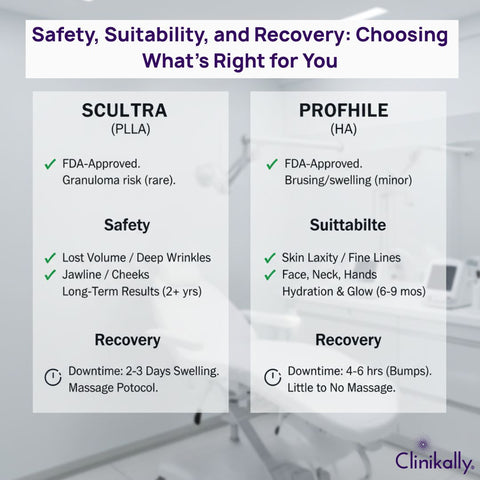
While Profhilo and Sculptra both aim to renew the skin, their chemicals, depth of action, safety concerns, and recommended candidates differ greatly. Understanding these distinctions is critical to selecting the therapy that best suits your skin's needs, lifestyle, and recovery tolerance.
-
Safety profile: Profhilo is produced from pure hyaluronic acid (HA), a naturally occurring component in the skin. It contains no cross-linking agents, making it biocompatible and low-risk. The risk of allergic responses is minimal. There is no volumising impact; therefore, the risk of overcorrection is nearly zero. Sculptra, on the other hand, is composed of poly-L-lactic acid (PLLA), a biocompatible and biodegradable polymer commonly used in surgical sutures. Triggers collagen formation by regulated inflammation, which may produce local swelling, bruising, or nodules (rare but possible) and minor unevenness during collagen development.
-
Suitability: Profhilo is appropriate for people aged 28 and up, particularly those who have dull, dry, crepey skin, early symptoms of aging (fine lines, diminished firmness), and sagging in difficult-to-treat areas (neck, hands). Ideal for both preventative and active renewal. Not appropriate for major volume restoration. You have high hopes about dramatic lifting. Sculptra, on the other hand, is ideal for people aged 35-60+ who have volume loss or facial hollowness, mild to severe sagging, deep wrinkles, or structural aging, as well as those looking for long-term rejuvenation and contour improvement. Not recommended if you have active skin infections or autoimmune problems, desire immediate results, and prefer a non-volumizing treatment.
-
Recovery time: Profhilo recovery is minor, with moderate redness, swelling, or small lumps at injection sites (which generally dissipate in 1-2 days). It is possible to return to work the same or following day. Sculptra Recovery, on the other hand, is mild; swelling or bruising may last 3-7 days; it is necessary to follow the "5-5-5 massage rule" (massage for 5 minutes, 5 times a day, for 5 days) to prevent the danger of lumps; and no cosmetics or hard exercise for 24-48 hours.
Who Should Consider Sculptra or Profhilo?
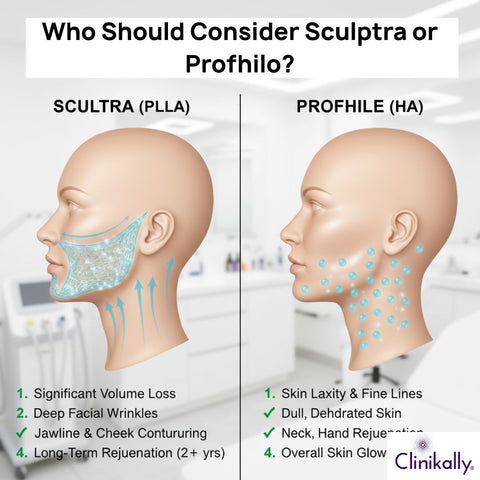
Choosing between Sculptra and Profhilo is determined by your age, skin issues, desired results, and how you want your therapy to go. Each injectable is intended to treat various aspects of aging and skin quality; therefore, determining which one best suits your skin type and goals is critical to attaining natural-looking, long-lasting results.
-
Profhilo is great for people looking for skin rejuvenation without adding volume. It concentrates on hydration, elasticity, and texture enhancement, making it ideal for treating early signs of aging or dull skin. Best for 30s to early 50s (but suitable for skin quality at any age), dehydrated or crepey skin, fine lines and early laxity (especially in the lower face, neck, or décolletage), dull, tired-looking skin that needs hydration, uneven texture or loss of glow, thin or fragile skin, and preventative anti-aging in younger patients. People who do not want volume or fillers but want to look more youthful. Those getting ready for or recovering from various treatments (such as lasers and microneedling). Patients with sensitive skin are looking for a low-risk, biocompatible solution. Busy people needing minimal downtime.
-
Sculptra is ideal for people with facial volume loss, drooping, or deep creases. It progressively stimulates your body's natural collagen, making it suitable for deeper rejuvenation and structural support. Best for people in their late 30s to 60s or older who have moderate to advanced signs of aging, such as hollow cheeks, sunken temples, or jawline sagging; loss of definition in the mid- or lower face; skin that has thinned and lost firmness with age; long-term collagen rebuilding; deep nasolabial folds; marionette lines; or general laxity. Individuals who desire natural, steady improvement over time. Patients who do not prefer the "overfilled" appearance of conventional fillers. Those seeking long-term structural support without synthetic volume. People agreed to a series of treatments and massage protocols.
Treatment Timeline and Downtime Differences
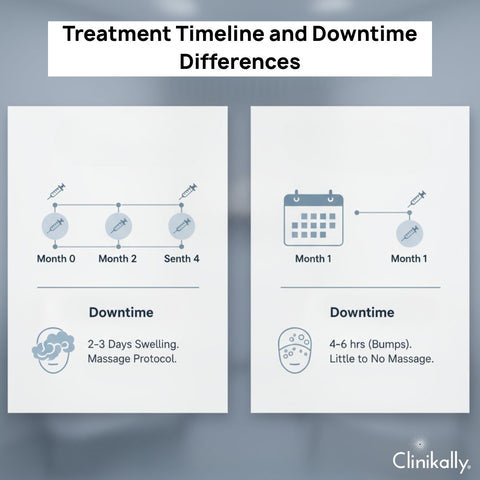
When deciding between Profhilo and Sculptra, understanding their treatment schedules, recuperation timetables, and how quickly results appear is critical for planning. These two injectables function very differently, and the amount of downtime required varies substantially.
Profhilo: It is a hydration-focused injection manufactured from pure hyaluronic acid. It's intended to improve radiance, suppleness, and smoothness without increasing volume or structure. The therapy timeline includes an initial regimen of two sessions spaced four weeks apart. Some people may benefit from a third session (particularly those with aged or dry skin). Maintenance is performed every six months, or two to three times per year. The results timeline, which includes days 1-3, includes skin that appears moisturized and plumper. During weeks 1-2, the radiance and texture significantly improve. Weeks 4-6 show the best results—the skin feels tighter, more elastic, and luminous. Up to 6 months, the results gradually diminish unless topped up. Downtime may include little bumps at injection sites that last a few hours to 1-2 days, as well as moderate redness or edema. No massage or stringent aftercare. Most people return to work or normal activities immediately.
Sculptra: It contains poly-L-lactic acid, which encourages the skin to produce its own collagen. It is used to restore volume, stiffness, and enhance facial structure. Treatment timeline, which includes Typically, 2-4 treatments are spaced 4-6 weeks apart and repeated every 18-24 months, with annual micro-dose touch-ups. The results timeline, which includes weeks 1-2, may involve early swelling that temporarily masks volume reduction. Collagen production begins in weeks 3–6, and modest firming is noted. Months 3-6 see full results emerge gradually. Lasts 18-24 months or longer, depending on skin and treatment quality. Downtime, such as swelling, bruising, or discomfort at injection sites, might last 2-7 days. The massage treatment called for 5 minutes of massage, 5 times per day, for 5 days. Avoid cosmetics, intense workouts, and alcohol for 24-48 hours.
Possible Side Effects and Post-Care Considerations

Profhilo and Sculptra are both regarded as safe and effective injectables, although they are not without danger. Understanding the potential side effects, how to manage recovery, and what aftercare procedures to implement is critical for achieving the best results and a smooth post-treatment experience.
-
Potential adverse effects: Profhilo is made of pure hyaluronic acid (HA), which makes it biocompatible and well-tolerated. Common, moderate side effects (1-3 days) include small lumps or swelling at injection spots, faint redness or bruising, discomfort or slight itching, and a tight or "pulled" skin feeling. Sculptra employs poly-L-lactic acid (PLLA), which induces collagen via inflammation and necessitates careful skill. Common, mild side effects (3-7 days) include swelling and bruising, pain or warmth, transient asymmetry, and a sense of fullness in treated areas.
-
Post-care guidelines: Profhilo takes little effort after treatment, making it extremely patient-friendly. Avoid touching or applying makeup after 6-12 hours, maintain hydrated to aid HA function, and utilize light skincare for 2-3 days. However, because of its collagen-stimulating properties, Sculptra requires more dedication. Follow the 5-5-5 massage guideline, which includes massaging for 5 minutes, 5 times a day, for 5 days (prevents nodules and improves even distribution), using a cold compress to reduce swelling/bruising (for the first 24 hours), and sleeping with your head elevated the first night. Avoid hard workouts (48-72 hours), alcohol and blood thinners, facial treatments or massages (unless indicated), and makeup (during the first 24 hours if bruised or swollen).
Tailoring Injectable Treatments to Your Unique Skin Needs

Skin rejuvenation is not a one-size-fits-all process. Your age, skin type, issues, and goals all influence the best injectable treatment option for you. Whether you want to hydrate and glow or lift and firm, understanding how to tailor your technique with Profhilo, Sculptra, or both is essential for achieving natural, long-lasting results. To tailor injectable treatments to your specific skin needs, you should first analyze your skin's current state, then match treatments to key skin concerns, combine strategically for full-face rejuvenation, consider age and lifestyle, modify based on skin type, and consult a professional injector.